
The interface that matters isn’t a screen. It’s you.
Are you using AI to inform your judgment, or are you using it to replace it?

We are currently witnessing a massive, high-speed regression in leadership.
In the rush to “AI-enable” everything, organizations are committing a fatal category error: they are outsourcing human sense-making to a statistical model.
If you are using AI to perform your stakeholder analysis, your change impact assessments, or your risk analysis, you aren’t “innovating.” You are reverting to a 21st-century view of the organization as a cold, predictable machine.
But the 21st century doesn’t run on machines. It runs on living, mutating, social ecosystems. And machines cannot sense a living system.
AI can’t “Feel the Room”
AI is a master of data, logic, and language. But in a social system, data is only the tip of the iceberg.
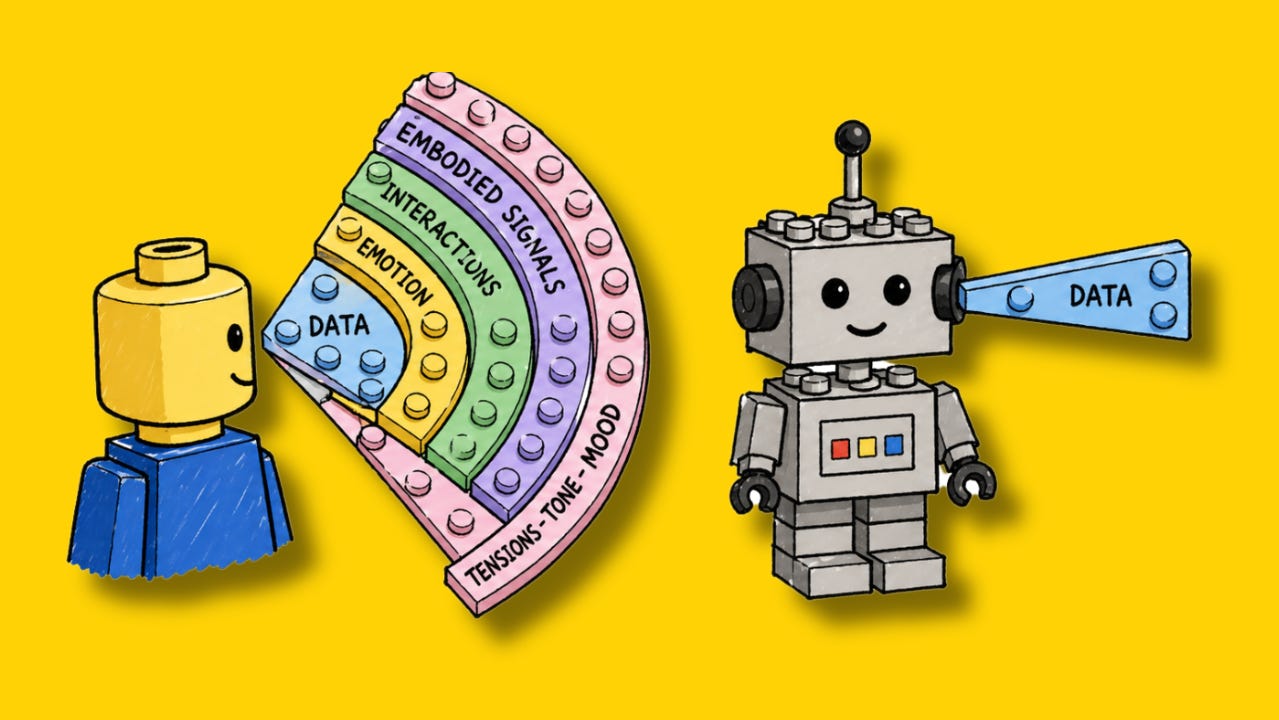
Hundreds of thousands of years of human evolution have gifted us with an embodied “Human Interface” designed to pick up on the signals a machine literally cannot see.
When you outsource your sense-making to AI, look at what you lose:
The tension & tone: AI reads the transcript; humans feel the silence in the meeting.
The emotional subtext: AI analyzes the sentiment; humans sense the underlying fear of replacement.
The embodied signals: AI processes text; humans read the subtle shifts in posture and mood that signal a project is about to derail.
AI has no direct interaction with context. It does not know what is happening in the “real world.” It only knows what is happening in its training data.
The 95% failure trap: Speed ≠ Sense-making
Why is there a 95% failure rate for enterprise AI? Because we have prioritized output speed over systemic depth.
Organizations are stuck in a “Sequencing Problem.” They design AI solutions for theoretical, “clean” workflows before observing how work—and the social tensions around it—actually happens on the ground.
The result? We create more outputs faster, but we aren’t performing deep sense-making. We are just “pushing buttons” more efficiently.
The machine view: Buy the tool → Generate the report → Force the change.
The ecosystem view: Probe the environment → Observe the social response → Respond with human judgment.
The latter is where real ROI lives. The former is why most AI pilots stall in “pilot hell”.
Reclaim the Human Interface
The “Impossible Choice” leaders feel they face—between rigid off-the-rack tools and complex, messy human systems—is a false one.
The solution isn’t to reject AI; it’s to stop treating it as a substitute for your own biological “Operating System.” AI is a co-worker for execution, but it is a disaster as a substitute for accountability.
The 21st-century organization already has enough button-pushers. What it desperately needs are sense-makers.
Change doesn’t happen because of an algorithm. It happens within the context of social systems. If you can’t feel the system, you can’t change it.
Exploration
Are you using AI to inform your judgment, or are you using it to replace it?
If these thoughts resonated, share it with a leader who’s navigating this transformation. We’re all learning together.
🔗 The AI ROI Trap: Why we buy tools, but forget to work
🔗 Human-AI rules for high-value work
🔗 DOWNLOAD The Human AI Delegation Playbook
🟡 I’m Patrycja Pielaszek, transformation trainer, hybrid coach, and catalyst of 𝗔𝗜𝗟𝗘𝗩𝗔𝗡𝗖𝗘 • 𝗧𝗵𝗲 𝗛𝘂𝗺𝗮𝗻 𝗜𝗻𝘁𝗲𝗿𝗳𝗮𝗰𝗲, exploring how leaders integrate AI with human systems, wisdom & emotional intelligence.
“The future won’t be led by those who master AI alone, but by those who master the interface between AI and humanity.” — Patrycja Pielaszek